As narrated by Apio Anyai Angioletta, Paediatric nurse.
I’m going to give a brief history of the Ebola outbreak in Lacor hospital, which happened in the year 2000. The disease started spreading in October, following the death of three nursing students. Panic began in the hospital and the training Institute. At this time, Dr. Lukwiya was in Kampala. He was made aware and came back to the hospital immediately. He then assessed the situation. A post-mortem for one of the bodies was done and taken for investigation. He later came and talked to all the health workers, urging them to be calm.
The following day, Dr. Lukwiya did his rounds in the Medical Ward, where many patients were showing signs and symptoms similar to the disease that killed the nursing students. He selected and put aside everyone presenting those similar symptoms. A team of volunteer health workers was formed under his guidance, which comprised the nursing team, the surveillance team, the burial team, and the community task force in the district. The Ministry of Health and the CDC were also informed about the strange disease.
Eventually, the post-mortem result, which was taken early from one of the deceased bodies, came back and confirmed positive for Ebola. Immediately, the volunteer staff gathered to start work in the isolation ward. The work schedule was in shifts of Morning, afternoon, and night, and feeding was done by a good Samaritan group that would always come and feed patients.
Meanwhile, the disease continued to spread, and many people were infected in the villages and the community. There was a problem, though; the community thought people suffering were possessed by witchcraft. Some resorted to going to witch-doctors. But, Volunteers started going to the community to screen people; those who tested positive were brought to the hospital immediately.
Suspected patients were put in the isolation ward for observation for 21 days. And if they are Ebola-free, they send them back home. Some places were also opened to manage rising cases, like Gulu regional referral hospital. In total, two hospitals were managing the situation. Lacor hospital and Gulu regional referral hospital.
Our Brother Elio Croce used to go to the villages with the government team to pick people who were showing signs of Ebola and brought them to the hospital for screening.
Days kept passing, and people were dying. No antibiotic was given at this point; it was supportive treatment. When there was dehydration, we rehydrated them. If there is a fever, we give them plenty of fluids and some painkillers, something to reduce the fever. Because there is was no cure.
The hospital ended up closing only to manage Ebola cases. A burial site was opened at Bardege Airfield, where all dead bodies were being buried. Fear in the community kicked in, and people started panicking.
The government later started showing support. They gave the hospital equipment. Protective gear and disinfectants. Cleaners volunteered to help clean the hospital. We struggled from October, and people kept increasing. But due to the strict control of the spread of the disease. Towards the end of December, things were a bit fair.
Unfortunately, Dr. Mathew Lukwiya picked up the disease from one of our staff. He was restless. He started feeling the signs and symptoms. A few days passed, and he thought it was fatigue. Then later he just said, “People, I’m not well.”
“I need to be away from you people. He isolated himself in his house. We could go and check on him. Within one week, we found that his condition was deteriorating. Then we prepared a room for him in the ward. We took his blood sample and sent it to the CDC for testing.
The result came back positive for Ebola. This one really demoralized me more because I was very close to him. We were afraid to tell the other patients that their doctor was sick because it would make them more disturbed. We had to inform the wife that the doctor had contracted the disease, but it was very difficult. Finally, we told her, and she came immediately from Kampala. We allowed her to visit him, dressed in full protective gear. She would pray together with him. Her visits were very brief. Five minutes was even too much. His condition continued deteriorating, his breathing became unstable, and we put him on ventilation.
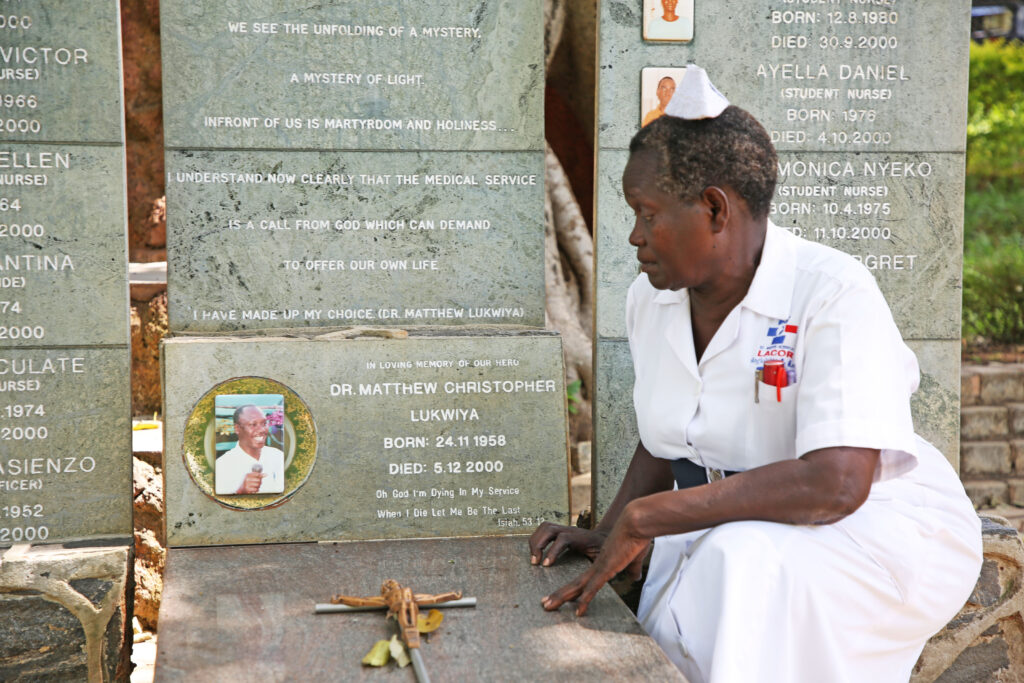
Dr. Mathew Lukwiya’s last moments
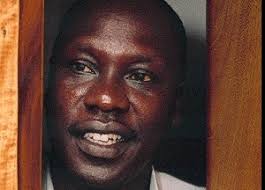
Dr. Mathew Lukwiya
I remember him telling me that “Sister, things are worsening. I’ve tried to fight. The battle is almost over. Now I’m seeing that I’m also going. The time has come for me to go. That I know. I’m going. But if I go, I’ll be at the doorway. Nobody is going to die now. I’ll tell my God that enough is enough.” Then he started singing a song about the war. It’s a Bible song, but I cannot remember it well.
All of us broke down. I said, “No, doctor, it will not be like that.”
And it was on the 5th of December, 2000, when he died. After his death, those who were infected with Ebola all survived. And after him, there was no more death. And in January 2001, they declared Uganda Ebola-free. And he was buried within the hospital at the Grotto. Other people were buried in the burial ground.
May all their souls rest in peace.