When most people think about St. Mary’s Hospital Lacor, they think of healthcare, healing, and saving lives. Few know that behind the scenes exists a dedicated team of volunteers trained to respond to one of the most dangerous emergencies imaginable, fire.
For more than fifteen years, Lacor Hospital’s Fire Response Team has served as a critical pillar of safety within the hospital and an important emergency response resource for surrounding communities.
The team’s origins trace back to a collaboration with Italian firefighters who regularly visited the hospital as technical volunteers and supporters of the late Brother Elio Croce. Recognising the growing size and complexity of the hospital, they identified the need for an organised firefighting unit capable of protecting patients, staff, infrastructure, and medical equipment.
According to Santo Uma Opoka, Deputy Technical Manager and Commandant of the Fire Response Team, the initiative began with basic firefighting training delivered by experienced firefighters from Italy, including Lorenzo De Martin, a former fire brigade commander at Milan Airport.
 “We started with simple firefighting skills such as handling pumps, understanding fire safety, and learning how to respond during emergencies,” Santo explains. “Over time, the training expanded significantly.”
Through support from Italian partners, Lacor Hospital acquired firefighting trucks and equipment, enabling the team to undertake more advanced training. Members learned vehicle operation, ladder rescue techniques, emergency entry procedures, and the use of breathing apparatus for firefighting operations.
Additional expertise came from international collaborators, including firefighters from the Kansas City Fire Department in the United States. Through these partnerships, the team received training in vehicle extrication, rescue operations, and community fire prevention awareness.
Today, the Fire Response Team consists of nearly 30 volunteer members drawn from various departments across the hospital, including technical services, nursing, and administration. Organised into four rotating teams, members remain on standby to ensure rapid response whenever emergencies arise.
“Fire can occur at any time,” says Santo. “In a hospital environment, where there are vulnerable patients and highly valuable equipment, preparedness is essential. Our responsibility is not only to fight fires but also to evacuate patients and protect lives.”
That preparedness was recently put to a major test.
Responding to Disaster at Awer Trading Centre
On the morning of 30th May 2026, the Fire Response Team received an urgent alert about a serious road traffic accident along the Gulu–Juba Highway at Awer Trading Centre.
Two trailers travelling in opposite directions had collided head-on and immediately caught fire.
Charles Opiyo, one of the Fire Response Team leaders, recalls receiving a call from the team’s commandant shortly after the incident occurred.
“I mobilised the available team members immediately, and we rushed to the scene,” he says.
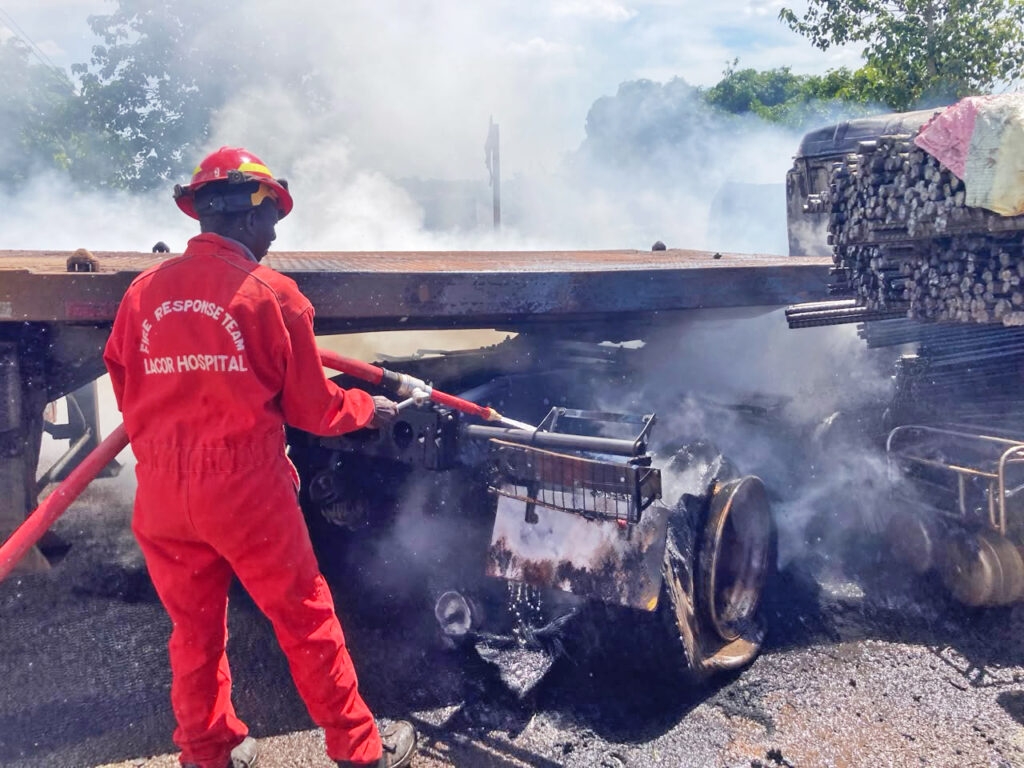
Upon arrival, the firefighters encountered a challenging and dangerous situation. Thick black smoke filled the air as flames engulfed the front sections of both trailers. Crowds had gathered around the accident site while security personnel attempted to manage the scene.
The greatest concern was the risk posed by burning fuel.
“When fuel is involved, the situation becomes much more dangerous,” Charles explains. “As we fought the fire, fuel continued leaking from one of the vehicles, increasing the risk of further spread and possible explosions.”
Using high-pressure water from the fire engines and carbon dioxide extinguishers, the team worked tirelessly to contain the blaze. Recognising that additional water would be needed, a second Lacor firefighting truck was dispatched to reinforce the operation.
Fortunately, local community members had already managed to rescue the driver who had initially become trapped in one of the vehicles. The second driver escaped on his own shortly after the collision.
While no lives were lost in the fire itself, the operation remained highly complex due to the nature of the burning fuel and the busy highway environment.
Challenges beyond the Flames
For Francis Oweka, a hospital mechanic and member of the Fire Response Team, the challenges extended beyond firefighting.
After receiving the emergency call, he quickly mobilised additional team members and drove the backup fire truck to the scene.
One of the greatest difficulties was controlling the large number of people and vehicles around the accident site.
“The accident happened in the middle of a busy highway,” Francis recalls. “Many people wanted to get closer to the scene, and traffic was still trying to move through the area. Some of our team members had to help control movement while others fought the fire.”
Despite these obstacles, the team remained focused on protecting lives and preventing further destruction.
Their efforts paid off.
Although the front sections of the trailers sustained significant damage, firefighters successfully prevented the fire from consuming the entire vehicles and causing a potentially much larger disaster.
A Mission of Service
The Fire Response Team operates largely on a voluntary basis, driven by a commitment to service and a desire to protect the community.
For Charles, that commitment is what keeps the team ready whenever the alarm sounds.
“What motivates us is knowing that we can save lives,” he says. “Our members are hardworking and dedicated. They respond without expecting payment because they know their work makes a difference.”
Over the years, the team has responded not only to incidents within Lacor Hospital but also to emergencies across the region, often working alongside the Uganda Police Fire Brigade and other emergency services.
From hospital safety to highway rescues, the Lacor Fire Response Team continues to embody the hospital’s mission of preserving life, protecting communities, and serving those in need.
As Santo Uma Opoka puts it, the guiding principle of every firefighter remains clear:
“Our motto is to save lives first, then property.”
And on the morning of 30th May at Awer Trading Centre, that mission was once again fulfilled.