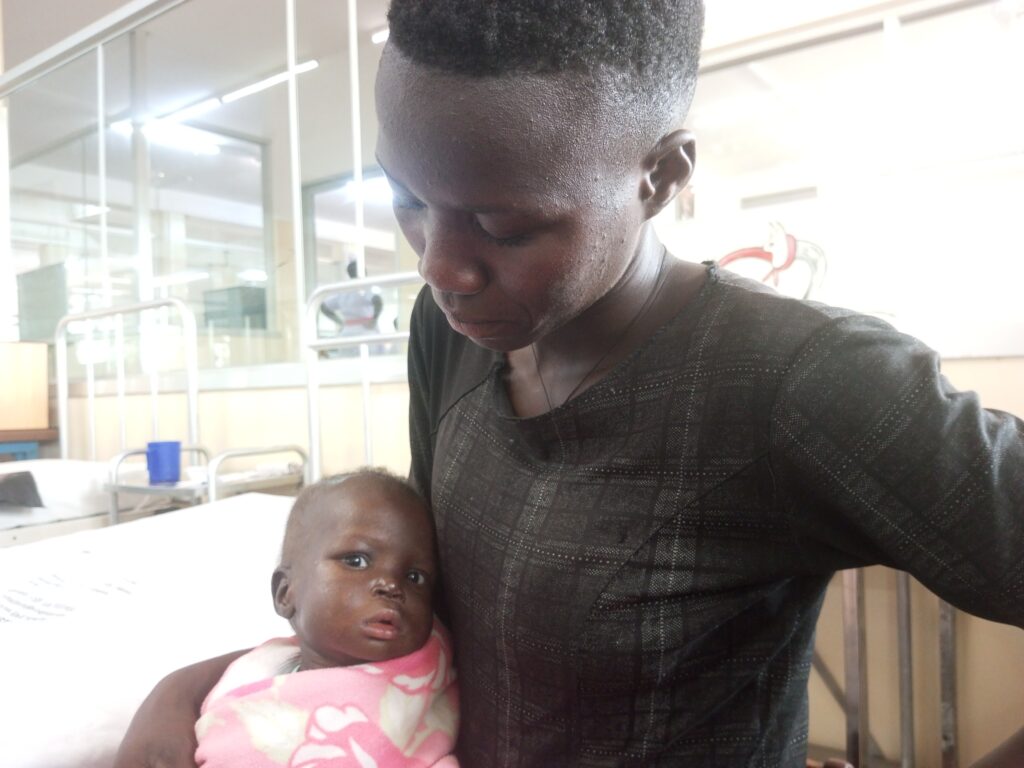
Lamaro is only one-year-old, but her life has already been a fight for survival. When she arrived at Lacor hospital, she was dangerously ill, her tiny body weakened by severe malnutrition and measles. For a full month, she has remained under close medical care, hovering between fragility and hope. The odds were not in her favor.
Lamaro comes from Rwotobilo in Gulu, where her mother, Aciro, works as a farmer. Like many parents in the region, Aciro does everything she can with the little she has. But sometimes, effort alone is not enough. Limited access to nutritious food, the burden of illness, and the daily demands of survival can quietly stack the odds against a child.
By the time Lamaro was brought to Lacor hospital, her condition had already taken a heavy toll. At one year old, she had not yet begun to crawl or walk. Her illness had robbed her not just of strength, but of crucial developmental time. For many children, the first year of life is filled with milestones, first steps, first movements, first explorations. For Lamaro, it became a battle to stay alive.
But her story did not end there. Day by day, with careful feeding, medical treatment, and constant monitoring, Lamaro began to respond. The same body that ha d been so weak started to regain strength. Slowly, almost imperceptibly at first, signs of recovery emerged. A small movement. A little more energy. A stronger cry.
Today, Lamaro is still on her journey, but she is no longer defined only by her illness. She now faces a new challenge: learning to crawl, to stand, and eventually to walk. While many children reach these milestones earlier, Lamaro’s path is different. It is delayed, yes, but it is still possible.
And that possibility matters.
Her recovery is not just a personal victory. It is a reflection of what timely medical care, proper nutrition, and sustained support can achieve, even in the most difficult circumstances.
Behind Lamaro’s progress are the tireless efforts of health workers and organizations committed to fighting malnutrition. These are the people who ensure that children like Lamaro are not forgotten, that they receive therapeutic feeding, essential medicines, and the chance to recover. Their work often happens quietly, without recognition. But for families like Aciro’s, it makes the difference between loss and hope.
Lamaro’s story is a reminder that malnutrition is not just a statistic. It is real, it is personal, and it affects the most vulnerable. Yet it is also preventable and treatable when the right support systems are in place.
As Lamaro continues to heal, her journey stands as both a warning and a call to action. No child should have to fight this hard just to survive. And no mother should have to watch her child suffer from a condition that can be addressed.


